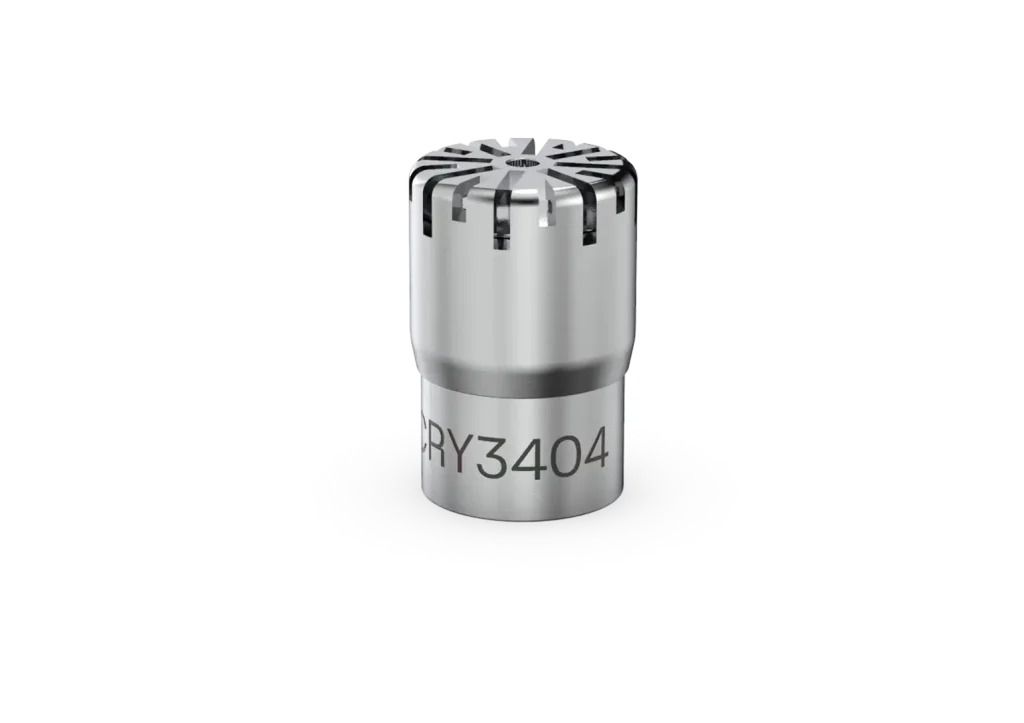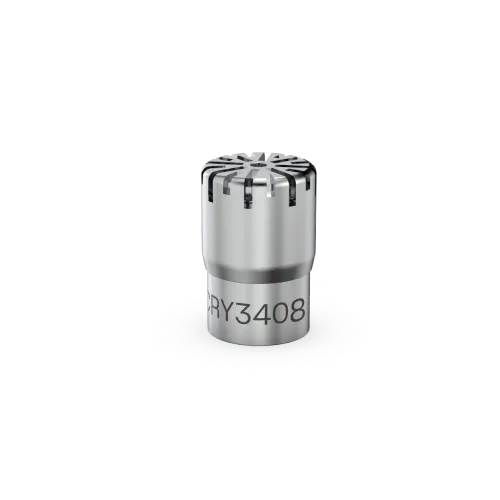
The CRY3408 is a 1/4″ pressure-field prepolarized measurement microphone purpose-built for acoustic measurements in the most extreme sound pressure environments. Capable of withstanding up to 180 dB SPL without distortion, it delivers clean and reliable data where standard microphones fail.
From rocket engine test stands to industrial blast chambers, the CRY3408 captures acoustic data under conditions that would overload conventional measurement microphones — making it an essential tool for aerospace, defense, and heavy industry applications.
Why Engineers Choose the CRY3408
- 180 dB maximum SPL — Purpose-built for the most demanding high-SPL environments in aerospace, defense, and heavy industry
- Distortion-free at extreme levels — 0.14 mV/Pa sensitivity keeps the output signal within usable range even under acoustic shock waves
- Prepolarized convenience — No external 200V polarization voltage needed; CCP/ICP compatible for fast field deployment
- Compact and rugged — 1/4″ form factor fits tight test setups and survives harsh environments
- Traceable accuracy — Calibrated to national and international standards for measurement confidence in critical applications
Applications
🚀 Rocket & Spacecraft Engine Testing

Measure acoustic emissions during static fire tests and launch sequences. The CRY3408 captures the extreme SPL generated by propulsion systems — often exceeding 170 dB at the test stand — providing critical data for structural vibro-acoustic analysis, launch pad design, and payload protection.
💥 Blast & Impulse Noise Testing

Characterize the acoustic output of controlled explosions, airbag deployments, gunshots, and ballistic testing. The CRY3408’s 180 dB capability and pressure-field design ensure accurate capture of impulsive, high-energy acoustic events — essential data for defense, automotive safety, and regulatory compliance.
🏭 Heavy Industrial Noise Measurement

Measure and monitor extreme noise sources in power generation facilities, turbine test cells, steel mills, and heavy manufacturing plants where SPL routinely exceeds the range of standard measurement microphones. Critical for occupational noise assessment, source identification, and noise control engineering.
✈️ Aerospace Acoustic Fatigue Testing
Support structural acoustic fatigue analysis for aircraft fuselages, engine nacelles, and satellite components. Measure the high-SPL acoustic environment — including DFAT (Direct Field Acoustic Testing) — that these structures must survive over their operational lifetime.
Understanding High-SPL Microphone Design
Why is the sensitivity so low (0.14 mV/Pa)?
High-SPL microphones are intentionally designed with low sensitivity. At extreme sound pressure levels (170–180 dB), a standard microphone would produce output voltages that exceed the input range of measurement systems, causing clipping and distortion. The CRY3408’s 0.14 mV/Pa sensitivity ensures the output signal stays within usable range — even at 180 dB.
What does “prepolarized” mean?
A prepolarized microphone has a permanent electrical charge built into the diaphragm, eliminating the need for an external 200V polarization voltage. This simplifies deployment — you can power it directly via CCP/ICP constant current from your analyzer or data acquisition system.
How to Choose: 1/4″ Microphone Comparison
| Feature | CRY3408 | CRY3401 | CRY3402 | CRY3403 |
|---|---|---|---|---|
| Sound Field | Pressure-field | Free-field | Pressure-field | Free-field |
| Sensitivity | 0.14 mV/Pa | 15.8 mV/Pa | 1.6 mV/Pa | 4 mV/Pa |
| Max SPL | 180 dB | 144 dB | — | — |
| Best For | Extreme high SPL | General-purpose, low-noise | High-freq coupler testing | Ultra-high frequency |
| Typical Use | Rocket / blast / industrial | Environmental noise, QC | Cavity measurements | Ultrasonic R&D |
Quick selection guide:
- Extreme SPL (>160 dB)? → CRY3408 — the only choice for blast and rocket testing
- General-purpose measurement? → CRY3401 (best all-rounder)
- Coupler/cavity testing? → CRY3402
- Ultra-high frequency? → CRY3403
Frequently Asked Questions
Can the CRY3408 be used for normal (lower SPL) measurements?
Technically yes, but it’s not recommended. The low sensitivity means the signal-to-noise ratio at normal SPL levels (60–100 dB) will be poor. For general-purpose measurements, use the CRY3401 (15.8 mV/Pa). The CRY3408 is optimized for environments above 130 dB.
What other equipment do I need?
A typical high-SPL measurement chain: CRY3408 → compatible preamplifier → data acquisition system or analyzer. Consider the CRY3408-S01 set for a ready-to-use package. Ensure your data acquisition system has sufficient input range and sampling rate for your application.
How do I protect the CRY3408 in blast testing?
While designed for extreme SPL, protect the microphone from direct debris impact, extreme temperatures, and corrosive gases. Use appropriate mounting hardware and protective grids. Contact CRYSOUND for application-specific guidance.
How often should the CRY3408 be calibrated?
Annual calibration is recommended to maintain traceable accuracy. For mission-critical applications (aerospace, defense), more frequent calibration may be required per your quality management system. CRYSOUND offers professional calibration services.
Related Products
| Product | Description |
|---|---|
| CRY3408-S01 | Complete high-SPL microphone set — CRY3408 + preamplifier + cable, ready to use |
| CRY3401 | 1/4″ free-field microphone (15.8 mV/Pa) for general-purpose acoustic measurement |
| CRY3402 | 1/4″ pressure-field microphone for high-frequency coupler and cavity measurements |
Product Highlights
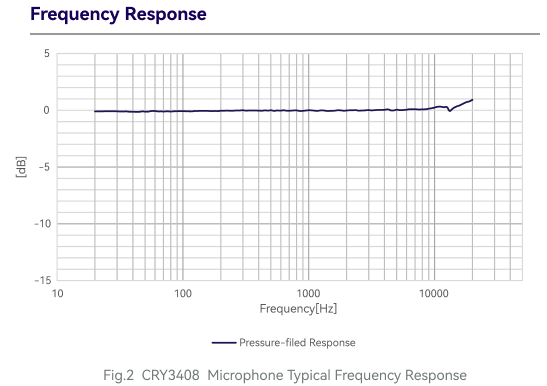
CRY3408 Measurement Microphone Typical Frequency Response
The graph (right) shows the frequency response curves obtained using the electrostatic excitation method.