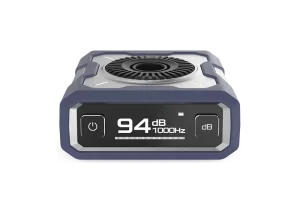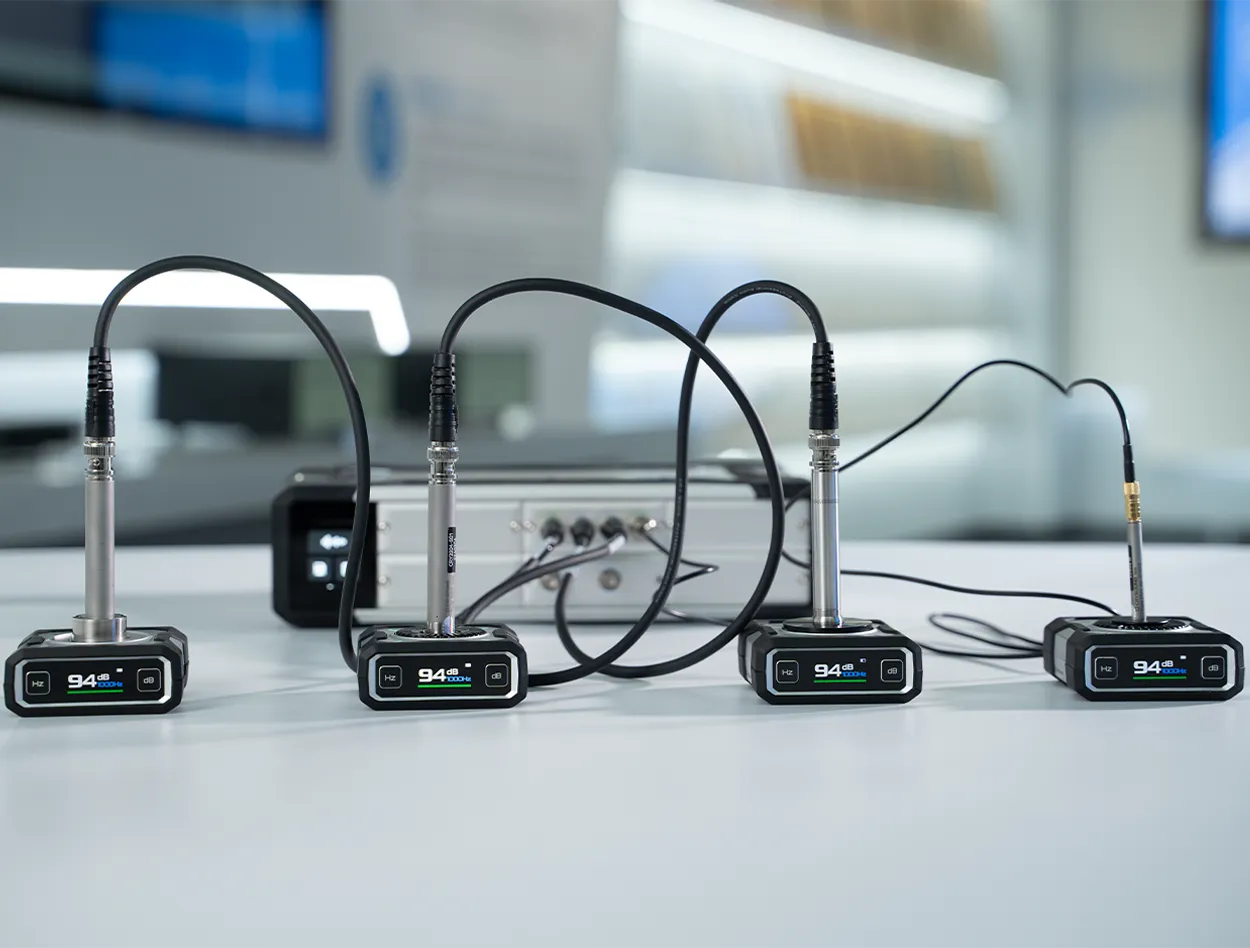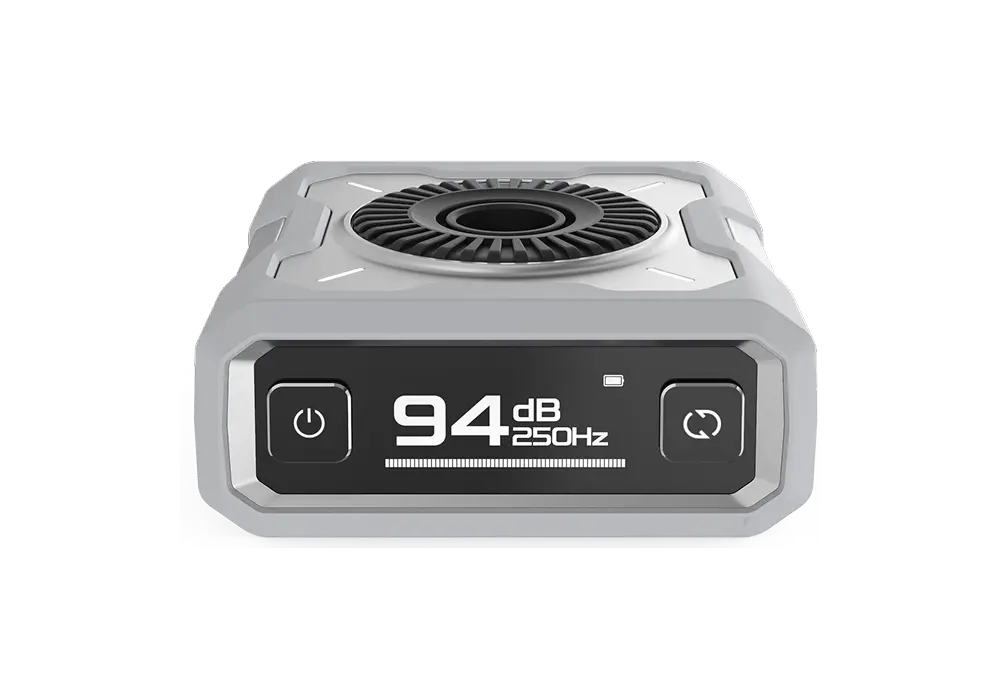
The CRY3012 is a portable acoustic calibrator compliant with IEC 60942:2017 Class 2. It supports a single frequency of 1000 Hz and a single sound pressure level of 94 dB. Built around an SPL feedback loop, it performs real-time sound pressure monitoring and closed-loop regulation to help maintain a stable and consistent calibration output. It supports USB-C charging with pass-through operation, quick top-up charging, and long runtime, and features automatic power-off. With a monochrome OLED display, a carbon-fiber housing, and four top-mounted status LEDs, it is suitable for basic calibration and routine verification applications.
NEW

CRY3012 Sound Calibrator

NEW

CRY3012 Sound Calibrator

The CRY3012 is a portable acoustic calibrator compliant with IEC 60942:2017 Class 2. It supports a single frequency of 1000 Hz and a single sound pressure level of 94 dB. Built around an SPL feedback loop, it performs real-time sound pressure monitoring and closed-loop regulation to help maintain a stable and consistent calibration output. It supports USB-C charging with pass-through operation, quick top-up charging, and long runtime, and features automatic power-off. With a monochrome OLED display, a carbon-fiber housing, and four top-mounted status LEDs, it is suitable for basic calibration and routine verification applications.

Product Highlights
USB-C Fast Charging with Pass-Through Operation

USB-C Fast Charging with Pass-Through Operation

The CRY3012 supports USB-C fast charging, allowing its internal battery to be fully recharged in approximately 2 hours, which is well suited for a full day of field use. It also supports pass-through operation while charging, significantly reducing downtime during extended tasks and improving overall efficiency for continuous operation.

USB-C Fast Charging with Pass-Through Operation
High-Brightness OLED Display

High-Brightness OLED Display

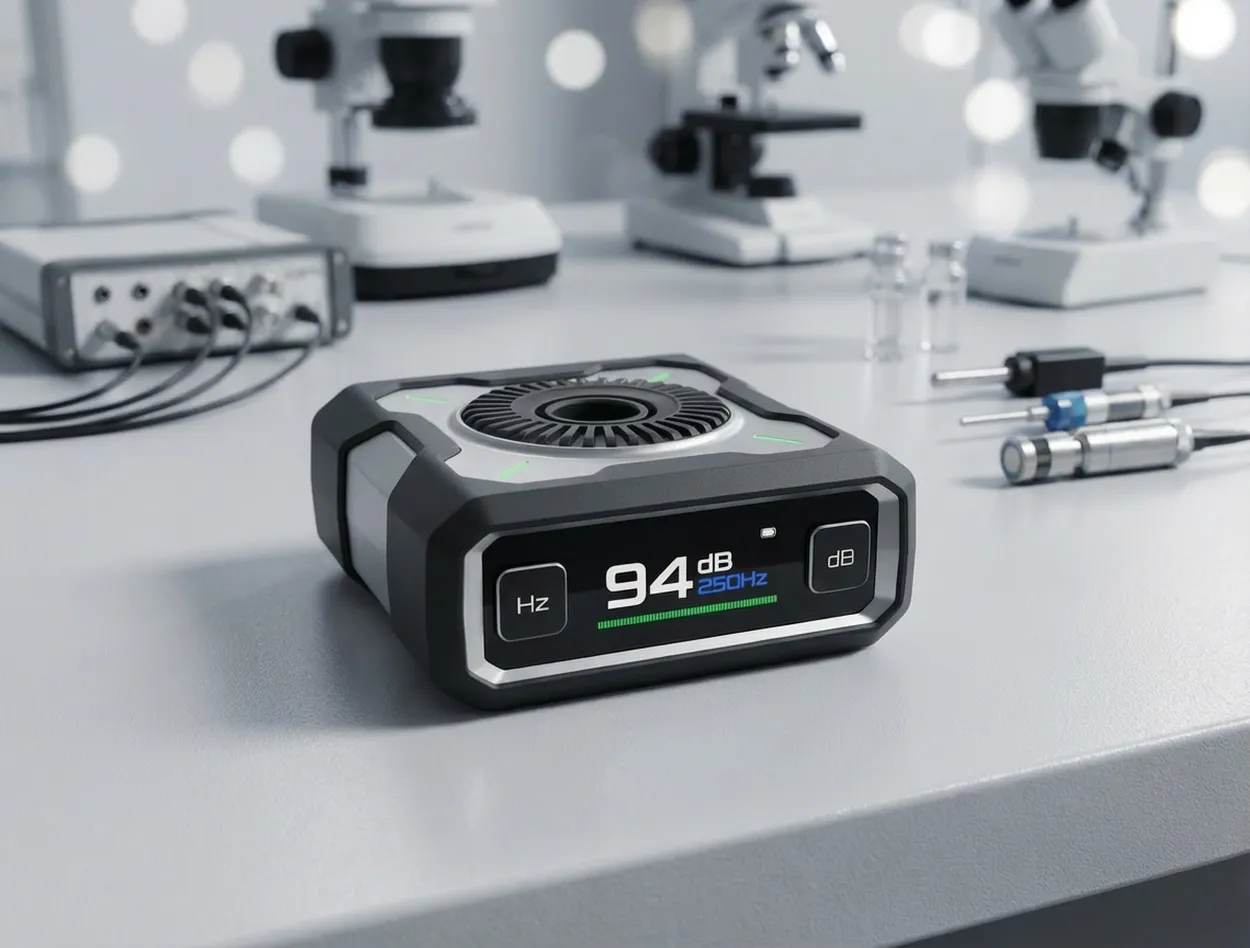
The high-contrast OLED display remains clear and easy to read in both bright and low-light environments, providing real-time visibility of frequency, sound pressure level, operating status, and battery level. This allows users to quickly confirm the output mode and improves overall control and efficiency during field operation.

High-Brightness OLED Display
Technical Specifications
Frequency
1000 Hz
Frequency Accuracy
< 0.5 Hz
Sound Pressure Levels (SPL)
94 dB
SPL Accuracy
< 0.3 dB
Short-term stability
< 0.1 dB
THD+N
< 2.5%
Supported Microphones
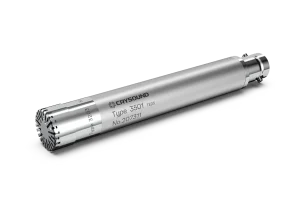
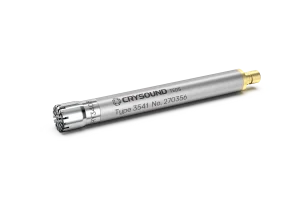
1" (with 1/2", 1/4",1/8" adaptor rings)
Operating Temperature
-10 °C to +50 °C (14 °F to 122 °F)
Operating Pressure
65 kPa ~ 108 kPa
Operating Humidity
0 to 90%RH,non-condensing
Storage Temperature
-10 °C to +50 °C (14 °F to 122 °F)
Power Supply
Built-in Li-ion Battery, USB-C (5V, 1A)
Compliance Standard
IEC 60942:2017 Class 2
Dimension
75mm×75mm×30mm
Weight
145g
Main Features

Related Products

CRY3018 Sound Calibrator: Intelligent Acoustic Calibration

For a long time, many engineers have seen sound calibrators as nothing more than little boxes that output 1 kHz at 94 dB: single-function devices, sensitive to the environment, not particularly pleasant to use in the field—yet still an indispensable link in any acoustic measurement chain. CRYSOUND’s all-new CRY3018 Sound Calibrator is designed to break this “good enough” mentality and upgrade sound level calibration from a passive, basic tool into an intelligent, reliable, and future-ready measurement reference. A Class 1 Smart Calibrator Built for the Field CRY3018 is a portable, high-precision sound calibrator fully compliant with IEC 60942:2017 Class 1. It can serve as a unified calibration reference in laboratories, on production lines, and in field measurements. Its core capabilities can be summed up in four key phrases: Dual-frequency calibration: 250 Hz / 1000 Hz Dual sound pressure levels (SPL): 94 dB / 114 dB Closed-loop SPL feedback with environmental self-compensation Intelligent power management with high-brightness OLED status display If traditional calibrators are still stuck in the era of fixed-level outputs, the CRY3018 is more like an intelligent calibration platform: it senses the environment in real time and compensates automatically. That’s where its truly disruptive value lies. Dual Frequencies + Dual Levels: One Device, More Scenarios In real-world work, a single 1 kHz, 94 dB calibration simply doesn’t cover all scenarios. Some standards or devices require calibration at 250 Hz. In noisy environments, a higher SPL is needed to secure enough signal-to-noise ratio. CRY3018 tackles all of these needs in one go: 250 Hz / 1000 Hz dual-frequency calibration: Meets different standards and device requirements for calibration frequency, better reflects the actual measurement bandwidth, and makes it easier to verify system frequency response more comprehensively. 94 dB / 114 dB dual SPL levels: 94 dB covers sensitivity calibration of conventional sound level meters and measurement microphones, while 114 dB effectively cuts through background noise in high-noise environments, ensuring the calibration signal stands out clearly. Typical performance figures include: Frequency accuracy: < 0.5 Hz SPL accuracy: < 0.2 dB THD+N: < 1% This means engineers no longer need to carry multiple calibrators with different frequencies and levels. One CRY3018 is enough to cover the vast majority of professional acoustic applications. Closed-Loop SPL Feedback + Environmental Three-Parameter Compensation: From “Rule-of-Thumb” Calibration to Self-Adaptive Calibration A major pain point of traditional calibrators is their extreme sensitivity to environmental changes. Even small shifts in temperature, humidity, or atmospheric pressure can introduce significant systematic errors—errors that historically have been estimated based on experience, or simply ignored. CRY3018 takes a fundamentally different architectural approach: Built-in SPL feedback system: It continuously monitors the actual sound pressure in the cavity and forms a closed control loop. If the output drifts, the system automatically adjusts to keep the SPL stable. Integrated high-precision temperature, humidity, and pressure sensors: These track three key environmental factors in real time. Combined with intelligent algorithms, the calibrator performs environmental self-compensation, effectively suppressing systematic deviations caused by environmental changes. In simple terms: Before: The environment changed, so humans had to worry and estimate. Now: The environment changes; the calibrator senses it and compensates automatically. This not only improves consistency and repeatability of measurement results, it also marks a genuine step into an environment-aware, data-driven smart calibration era—upending traditional workflows that relied heavily on experience and manual corrections. Intelligent Power Management: 5-Minute Fast Charge, Up to 1,000 Calibrations One of the worst nightmares for field engineers is this: “You’re ready to calibrate, and the calibrator is dead.” CRY3018’s power system is carefully engineered to avoid exactly that: USB-C fast charging with pass-through support (charge and use at the same time) About 5 minutes of quick charge provides roughly 1 hour of operation A full charge can support close to 1,000 calibration cycles On top of that, it integrates comprehensive safety and status management: Overcharge, over-discharge, and short-circuit protection Low-battery warning Auto power-on when a microphone is inserted, and auto power-off when removed In busy production lines or time-critical field tasks, CRY3018 can operate with minimal interruption, dramatically reducing the risk of interrupted testing due to power issues. Industrial Design and UX for Frontline Engineers CRY3018 is not just about stacking numbers on a spec sheet. Its emphasis on ergonomics and readability reflects a new product philosophy: Lightweight, high-strength carbon-fiber composite housing: Strikes a balance between weight and robustness; impact-resistant and scratch-resistant, comfortable for long periods of handheld use and frequent transport. High-brightness OLED display + auto-rotate via gyroscope: Whether you hold it vertically or horizontally, the screen automatically rotates to match the orientation. Readings remain clear in bright labs and outdoor environments. Top status LED + simple, intuitive button logic: White flashing: adjusting SPL Green solid: SPL stable and ready to use Red solid: low battery, shutting down soon While charging: yellow flashing; full charge: green solid Paired with intuitive interactions like short press to power on, long press to power off, and dedicated Hz / dB buttons to switch frequency and level, even first-time users can operate CRY3018 confidently without reaching for the manual. Full-Size Microphone Compatibility: A Unified Solution from Lab to Line CRY3018 supports 1" measurement microphones and, through adapters, is compatible with 1/2", 1/4", and 1/8" sizes, enabling: Laboratory-grade measurement microphone calibration Sound level meter calibration for environmental noise monitoring systems Sensitivity consistency checks for sensors on production lines Routine verification of acoustic test systems (audio analyzer + microphone arrays) For teams managing multiple microphone sizes and numerous test points, CRY3018 can act as a unified acoustic reference source, consolidating fragmented calibration workflows, reducing device variety, and simplifying management in a big way. More Than a Spec Upgrade: Rethinking How We Do Acoustic Calibration If you only look at the specs, CRY3018 is a leading, feature-rich Class 1 sound calibrator. But if you look at the entire workflow, it represents a new mindset: Calibration is no longer a check-the-box formality, but a smart, quantifiable, and traceable process. The environment is no longer an uncontrollable factor, but a parameter that can be sensed and compensated in real time. The calibrator is no longer a fixed-level box, but a unified reference platform that spans lab, field, and production line. What CRY3018 brings is not just a new generation of product—it’s a new answer to the question: What should acoustic calibration look like today? If your team is looking for a sound calibrator that truly fits both current and future measurement needs, the CRY3018 may be a strong starting point to redefine your entire calibration experience.

Sound Calibrator Explains Measurement Microphone Calibration

In day-to-day acoustic measurements, it’s common to hear: “Insert the measurement microphone into the calibrator, press the button, and the microphone is calibrated.” From an engineering and metrology perspective, that wording is an oversimplification. To place a sound calibrator correctly in the measurement chain, we should start with what it generates—and what it can (and cannot) verify. Core Function of a Calibrator A sound calibrator is essentially a reference sound source that generates a stable, known sound pressure level (SPL) at a specified frequency—typically 1 kHz (and 250 Hz on some models). Depending on the model, the nominal level is often 94 dB or 114 dB. During use, you compare the calibrator’s nominal SPL with the reading of the entire measurement chain (microphone + preamplifier + front-end or sound level meter) to confirm whether the indicated value matches the reference. In other words, a calibrator is primarily an on-site verification tool rather than a device that “calibrates” (adjusts) the microphone itself. It helps you answer one practical question: for a known SPL at a known frequency, is the system reading correct? Relationship Between the Calibrator and the Measurement Microphone Structurally, a calibrator mainly provides a controlled acoustic field at the microphone diaphragm. It does not change the microphone’s intrinsic characteristics—such as sensitivity, frequency response, linearity, dynamic range, or self-noise. If the microphone or preamplifier drifts due to aging, mishandling, temperature/humidity exposure, or mechanical shock, the calibrator can reveal the deviation—for example, a consistent offset from the nominal level. But the calibrator cannot “fix” the microphone. If the deviation is abnormal, unstable, or growing over time, you typically troubleshoot the chain (fit/seal, adaptor size, connector, cable, preamp gain, settings) and, when necessary, send the microphone and/or calibrator to a laboratory for calibration or service. Understanding “Calibration” from a Metrological Perspective In acoustic metrology, “calibration” generally means comparing a device to a higher-level reference standard and documenting its deviation (and, where applicable, a correction factor) with traceability to national or international standards. For measurement microphones, a rigorous calibration is typically performed in a controlled laboratory environment, using reference microphones and equipment that comply with relevant standards (e.g., IEC 60942 for sound calibrators and the IEC 61094 series for measurement microphones). It commonly includes multi-point testing across conditions and an uncertainty statement. In the traceability chain, a handheld sound calibrator is mainly an on-site step used to: 1) perform quick checks before and after measurements, 2) record drift during use, and 3) support decisions on recalibration or service. Therefore, it’s more accurate to say: you are using a calibrator to verify the measurement system on-site—not completing a formal microphone calibration. Also note: the calibrator itself is part of your traceability chain. To keep the check meaningful, ensure the calibrator has a valid calibration certificate and is used within its specified environmental range. Summary A calibrator is a very important on-site comparison tool in the measurement chain. It can: Provide a standard sound pressure level signal for measurement microphones Help engineers quickly check whether the measurement system is operating in a reasonable state At the same time, it must be clearly understood that: The calibrator does not directly “calibrate” or repair the microphone itself Formal microphone calibration must be performed in a standard acoustic laboratory and must follow metrological specifications and procedures In engineering practice, only by clearly distinguishing between “on-site verification” and “laboratory calibration” can we both efficiently carry out daily testing and ensure that measurement data are accurate and metrologically traceable. You are welcome to visit www.crysound.com to learn more about microphone functions and hardware solutions, or contact the CRYSOUND team of  demonstrations and application support.

Get in touch

If you are interested or have questions about our products, book a demo and we will be glad to show how it works, which solutions it can take part of and discuss how it might fit your needs and organization.

Support Support
Product Catalogs Product Catalogs Solutions Solutions User Manuals User Manuals Software Download Software Download Product Inquiry Product Inquiry Schedule Demo Schedule Demo Technical Support Technical Support +86-571-88225128 +86-571-88225128
Request Quote 0
Request Quote
This site is registered on wpml.org as a development site. Switch to a production site key to remove this banner.